



Calling behind the wheel: what is prohibited, what is the fine, and when does a criminal case follow?
According to Article 61a of the Road Traffic Regulations 1990, you may not hold a mobile electronic device, such as a telephone or tablet, while driving; since July 1, 2019, this also applies to bicycles. Operating a telephone placed in a holder is not prohibited, but if doing so causes danger or an accident, you may still face criminal prosecution under Article 5 or 6 of the Road Traffic Act 1994.
Below, we explain exactly what falls under the ban, what the fine will be in 2026, how standing still in a traffic jam works, and what happens if using a phone leads to an accident.
What exactly does Article 61a of the RVV 1990 prohibit?
The prohibition concerns holding, not calling or texting as such. Article 61a of the RVV 1990 prohibits the driver of a vehicle from holding a mobile electronic device while driving that can be used for communication or information processing.
A mobile electronic device includes, in any case, a mobile phone, a tablet, and a media player. Since the amendment of July 1, 2019 (Government Gazette 2019, 237), the ban applies to drivers of all vehicles. That means: car, motorcycle, moped, bicycle, and also tram.
Hands-free calling via a headset or in the car is therefore permitted. According to the explanatory notes accompanying the amendment, a smartwatch on the wrist is also not considered holding.
When is there a case of “holding on”?
According to the legislative history, "holding" means holding the device in the hand or clamping it between the ear and shoulder. The case law of the Arnhem-Leeuwarden Court of Appeal, which rules on appeals regarding Mulder fines, has further elaborated on this.
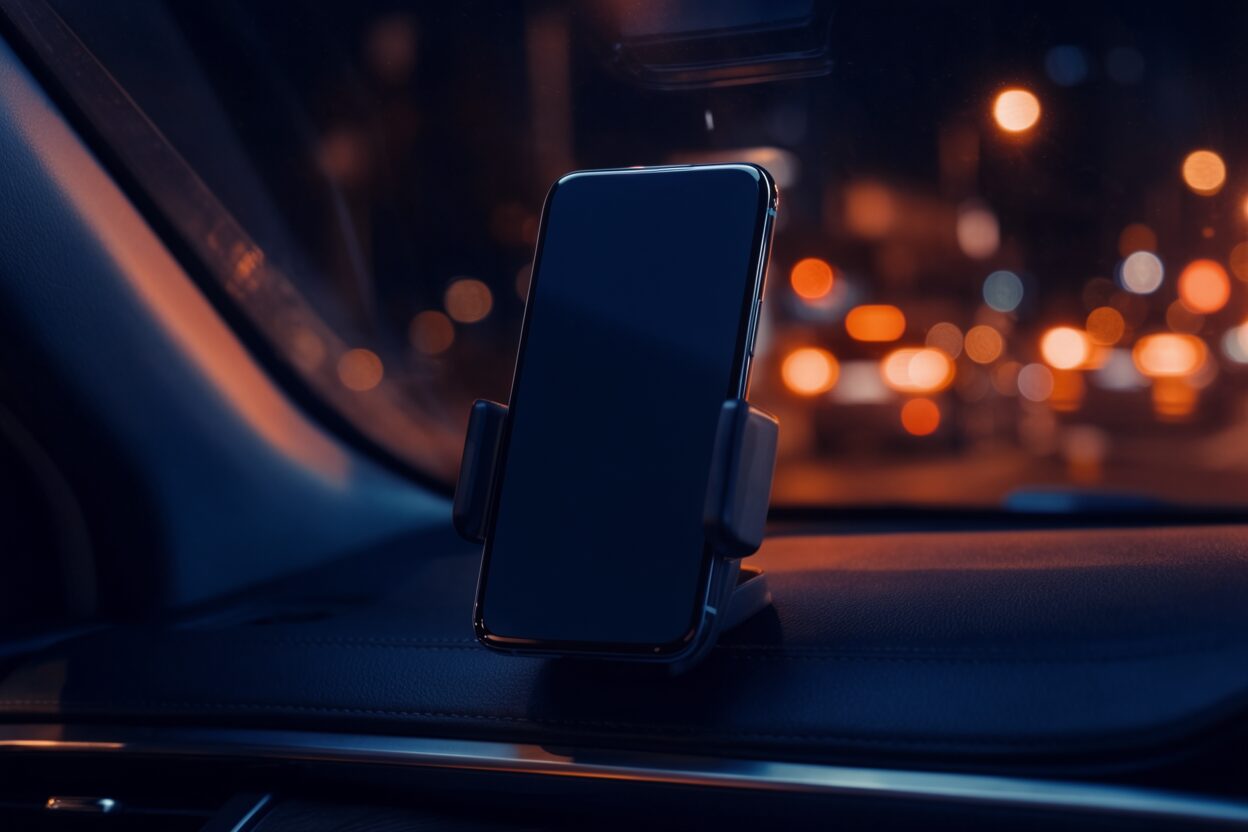
- Operating a phone in a holder is not holding it (ECLI:NL:GHARL:2018:2186).
- A phone on the lap or on the leg does not constitute holding (ECLI:NL:GHARL:2021:7637).
- A phone attached to the wrist with a mechanism is indeed being held, according to the explanatory notes on the 2019 amendment.
- Continuously pressing a hands-free earpiece against the ear is holding it; occasionally pressing a button on the cord is not.
In May 2026, the same court ruled that a phone placed in a holder and enclosed by hand is indeed being held. This concerned a ruling of May 13, 2026 (case number 200.356.666/01). The boundary therefore lies with the physical act: merely touching the screen in the holder is permitted, but grasping the phone in the holder is not.
What is the fine for calling behind the wheel in 2026?
In 2026, the fine for holding a phone in the car is €440, plus administrative costs. On a bicycle, the fine is €170 for drivers aged 16 and older.
This concerns an administrative sanction under the Administrative Enforcement of Traffic Regulations Act (Wahv, also known as the Mulder Act). You will receive the notice from the CJIB. In addition, the Public Prosecution Service deploys so-called focus cameras, which are cameras that recognize a driver holding a phone. A CJIB enforcement officer assesses each photo before the fine is sent to the vehicle owner.
Because it is a Mulder offense, there will be no criminal conviction or driving ban. That changes if your driving behavior was dangerous or led to an accident, as shown below.
Are you allowed to hold the phone when you are stationary in a traffic jam or at a traffic light?
The prohibition applies “while driving”. According to the explanatory notes to Article 61a of the RVV 1990, anyone who is parked or stationary with the vehicle may use a telephone in their hand.
A moving traffic jam does fall under the ban, even if it is moving very slowly. The regulator has explicitly rejected a proposal to allow telephoning in a moving traffic jam. The explanatory notes refer to a car rolling forward at walking speed as a borderline case.
In practice, the question of whether you were stationary or driving is often a matter of evidence. The officer's statement carries significant weight in this regard. A court ruled in 2024 that a mere denial is too brief in the face of a clear and concrete statement by the reporting officer (ECLI:NL:RBZWB:2024:7869).
What if you cause an accident through phone use?
In that case, it is no longer a matter of a fine, but of a criminal case. If you cause an accident resulting in bodily injury or a fatal outcome through negligence, you violate Article 6 of the Road Traffic Act 1994.
The maximum penalty is set out in Article 175 of the Road Traffic Act 1994. In the event of negligence, this is a three-year prison sentence for a fatal victim and one and a half years for injury. If the judge rules that you were driving recklessly, the maximums are six years and three years. Additionally, pursuant to Article 179 of the Road Traffic Act 1994, the judge may driving ban impose up to five years.
Recklessness is the most serious form of culpability. The judge considers all circumstances together, such as how long you looked at your phone, the speed, and the traffic situation. Phone use can therefore be a factor in determining whether there is culpability or recklessness. You can read more about this in our article on Article 6 of the Road Traffic Act. For the civil damages is liability under Article 185 of the Road Traffic Act of importance.
Can you also be prosecuted without an accident?
Yes. The Public Prosecution Service points out that dangerous traffic behavior caused by a phone, for example on one's lap, remains punishable under Article 5 of the Road Traffic Act 1994. The police can draw up an official report for this.
Article 5 of the Road Traffic Act 1994 prohibits conduct that causes danger or obstruction on the road. Operating a telephone in a holder can also fall under this if the driving behavior becomes evidently dangerous as a result. In the event of a violation of Article 5, the judge may impose a driving ban of up to two years (Article 179, paragraph 2 of the Road Traffic Act 1994). See also our article on dangerous driving behavior.
How do you appeal a fine for phone use?
You must first lodge an appeal against a Mulder fine with the Public Prosecutor within six weeks of the date of the decision (Article 6 Wahv). In the case of a fine for a focus camera, that appeal goes to the CVOM Public Prosecution Service.
If the public prosecutor rejects your appeal, you can go to the sub-district court. After that, in most cases, an appeal is possible to the Arnhem-Leeuwarden Court of Appeal. As a rule, to lodge an appeal, you must first pay the amount of the fine as security.
What can we do for you regarding using a phone while driving?
- We assess whether the conduct falls under “detention” according to the case law of the Court of Appeal.
- We request the photos or the official report and verify the observation.
- We draft the appeal to the Public Prosecutor or the Sub-district Court Judge.
- We assist you if an accident involving the use of a telephone leads to a criminal case under Article 6 of the Road Traffic Act 1994.
- We argue before the judge that there is no question of recklessness, if the facts give rise to that.
Summary
- Article 61a of the RVV 1990 prohibits holding a mobile device while riding, and since July 1, 2019, also on a bicycle.
- The fine in 2026 is €440 for a car and €170 for a bicycle, plus administrative costs.
- Operating in a holder is permitted, but according to the court, grasping the phone in the holder constitutes holding.
- Standing still is not driving; a slow-moving traffic jam is.
- In the event of danger or an accident, prosecution may follow pursuant to Article 5 or 6 of the Road Traffic Act 1994.
Frequently asked questions about calling while driving
Can I use my phone as a navigation system?
Yes, as long as the phone is in a holder and you are not holding it. According to the explanatory notes to Article 61a of the RVV 1990, you may use a phone in a holder to navigate or listen to music.
Do I get the fine as the registered owner even if someone else was driving?
In the case of a focus camera, the fine goes to the registered owner. Under the Wahv, the registered owner is generally liable for the fine, even if someone else was driving.
Does the ban also apply to a speed pedelec or e-bike?
Yes. The prohibition in Article 61a of the RVV 1990 has applied since July 1, 2019, to everyone driving a vehicle, so this also applies to cyclists with pedal assistance and drivers of a speed pedelec.
Questions about your case?
Email us a few sentences explaining what your question is about, via info@lawandmore.nlWe will let you know if we can help you and what the next step is.
This article provides general information and does not replace advice regarding your specific situation.