


Driving away after an accident: when is it punishable and what should you do in case of damage?
Driving away after an accident is punishable under Article 7 of the Road Traffic Act 1994 (WVW) if you know or ought to reasonably suspect that someone is injured or that another person has suffered damage. The most important exception: you may leave if you have properly given the other party the opportunity to establish your identity and your vehicle at the scene of the accident, unless you leave an injured person helpless.
Below you can read exactly what the law requires of you, what penalties apply, how parking damage works, and what you can do if you only realize later that you have hit something.
What does Article 7 of the Road Traffic Act say about driving off without stopping?
Article 7, paragraph 1 of the Road Traffic Act prohibits any person involved in a traffic accident from leaving the scene of the accident in three situations. This concerns who is involved in the accident, but also who caused the accident through their conduct.
- Part a: another person has been killed or sustained injury.
- Part b: someone else has suffered damage.
- Part c: an injured person is left in a helpless state.
The prohibition applies to every road user, including cyclists. The condition is always that you knew or should reasonably have suspected this. You therefore do not need to know for certain: even if you felt or heard a hard blow, the judge may assume that you should have suspected damage or injury.
When are you allowed to leave the scene of the accident?
You may leave the scene of injury or damage if you have given the other party a proper opportunity to establish your identity, as stipulated in Article 7, paragraph 2 of the Road Traffic Act. If you were driving a motor vehicle, your vehicle must also be identifiable, for example via the license plate.
This exception does not apply to part c. If you leave an injured person in a helpless state, this is a punishable offense, even if you have provided your details. In practice, it is advisable to remain until it is clear that the injured person is receiving help and the police have your details, should they arrive at the scene.
What is the penalty for leaving the scene of an accident?
Leaving the scene of an accident is always a criminal offense under Article 178 of the Road Traffic Act. The maximum penalty depends on the consequences of the accident.
| Situation | Maximum penalty |
|---|---|
| Hit and run after injury or death (Art. 7, paragraph 1, sub a) | 1 year imprisonment or a fine of the fourth category (€ 27,500) |
| Leaving the injured person helpless (Art. 7, paragraph 1, subparagraph c) | 1 year imprisonment or a fine of the fourth category (€ 27,500) |
| Driving on after only damage (Art. 7, paragraph 1, sub b) | 3 months imprisonment or a fine of the third category (€11,000) |
These maximums are set out in Article 176, paragraphs 2 and 5 of the Road Traffic Act (WVW). The fine amounts are those of Article 23 of the Criminal Code as of January 1, 2026. If you were driving a motor vehicle, the judge may additionally impose a driving ban of up to 5 years pursuant to Article 179, paragraph 1 of the WVW. You can read more about this in our article regarding the driving ban.
What does the Public Prosecution Service demand in practice?
The Guidelines for the prosecution of traffic accidents, dangerous driving behaviour and leaving the scene of an accident (2022R004) provide basic principles. In the case of minor material damage, this is a fine of €500 for someone without a prior conviction; for damage exceeding minor damage, it is €1,000.
In the event of a repeat offense, an unconditional driving ban is added: 2 months for minor damage and 4 months for more than minor damage. Anyone who leaves an injured person helpless without the accident being attributable to their fault faces a starting point of 2 months imprisonment and a 6-month driving ban.
What if you also caused the accident?
If you caused the accident resulting in injury or death through your fault, there is often also a suspicion under Article 6 of the Road Traffic Act. In that case, driving away is considered an aggravating circumstance according to the Public Prosecution Service guidelines.
An example from that guideline: in the case of a fatal accident caused by gross negligence, the starting point is a community service sentence of 240 hours and a one-year driving ban. If the driver also fled the scene, this becomes a seven-month unconditional prison sentence and a three-year driving ban. Read more in our article about Article 6 of the Road Traffic Act, death or injury caused by negligence.
What should you do in case of parking damage?
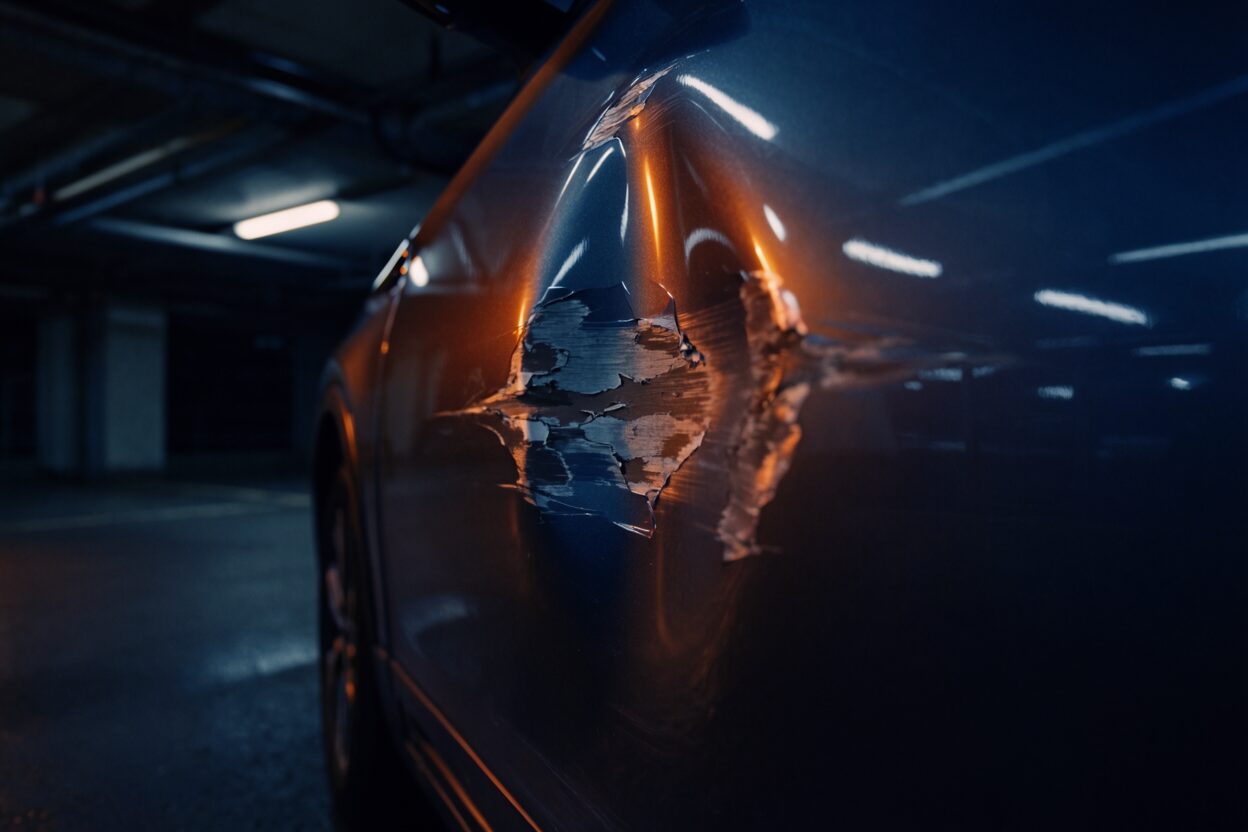
Article 7, paragraph 1, sub b of the Road Traffic Act also applies if you hit a parked car. You may only drive away once the owner has had a proper opportunity to establish your identity and your vehicle.
If the owner is not present, you can leave a note with your name, address, telephone number, and license plate number in a place where the owner is sure to find it. Whether that is sufficient depends on the circumstances: a note may blow away or be taken by someone else. Therefore, also report the collision to the police. This confirms that you have provided your details.
Where possible, take photos of the damage and the situation, and write down where and when it happened. This helps with the settlement with the insurer and if questions arise later.
What does driving away mean for your insurance?
Every motor vehicle owner is required to be insured for damage to others, in accordance with the Motor Vehicle Liability Insurance Act (WAM). In principle, the insurer compensates the victim's damages, even if you drove away.
However, most policy conditions do contain obligations, such as reporting damage in a timely manner and cooperating with the settlement process. If you fail to comply with these, the insurer may be able to recover the damages from you or refuse to compensate you for your own damage. What applies to you is stated in your own policy conditions. You can read more about who is liable for the damage on our page about liability in traffic and Article 185 of the Road Traffic Act.
What do you do if you realize later that you touched something?
If you did not know at the time that there was damage or injury, and you could not reasonably have suspected it, then Article 7 of the Road Traffic Act has not been violated. What counts is what you knew or ought to have suspected at that moment.
If you realize it later, for example due to damage to your own car, it is advisable to report the collision to the police as soon as possible and inform your insurer. By doing so, you demonstrate that you are not trying to conceal your involvement. If you are questioned as a suspect, you have the right to remain silent under Article 29 of the Code of Criminal Procedure and the right to a lawyer under Article 28 of the Code of Criminal Procedure. It may be wise to seek advice before making a statement. You can read more about the powers of the police on our page about surveillance and investigation.
What can we do for you if you are suspected of hit-and-run?
- We will discuss with you whether, when, and how you can still report to the police.
- We prepare you for the police interrogation or assist you during it.
- We assess whether the file shows that you knew or ought to have suspected the damage or injury.
- We assess whether you have provided sufficient opportunity to establish your identity, as required by Article 7, paragraph 2 of the Road Traffic Act.
- We conduct your defense before the public prosecutor or the criminal court, including regarding the duration of a driving ban.
Summary
- Article 7 of the Road Traffic Act prohibits driving on if you know or reasonably suspect that another person has suffered injury or damage.
- You may leave if the other party can properly establish your identity and vehicle, but never if you leave an injured person helpless.
- The maximum penalty is 1 year for injury or death and 3 months for damage only; in addition, a driving ban of up to 5 years is possible.
- In the event of parking damage, leave your details and also report the collision to the police.
Frequently asked questions about hit-and-run accidents
Is driving away after only causing minor damage also a punishable offense?
Yes. Article 7, paragraph 1, sub b of the Road Traffic Act also applies to damage without injury, such as a scratch on a parked car. The maximum penalty is lower: 3 months imprisonment or a fine of the third category.
I rode away as a cyclist after a collision. Does Article 7 also apply to me?
Yes, the ban applies to everyone involved in a traffic accident. A driving ban under Article 179 of the Road Traffic Act can only be imposed on the driver of a motor vehicle.
Is a note under the windshield wiper enough?
That depends on the circumstances. The goal is for the owner to be able to find you. Therefore, also report the collision to the police; this confirms that you have provided your details.
Will my driver's license be confiscated immediately if I drive off without stopping?
This is possible if the police determine that you have seriously endangered road safety, pursuant to Article 164 of the Road Traffic Act. The Public Prosecutor then decides whether the driving licence will be withheld or returned.
Questions about your case?
Email us a few sentences explaining what your question is about, via info@lawandmore.nlWe will let you know if we can help you and what the next step is.
This article provides general information and does not replace advice regarding your specific situation.